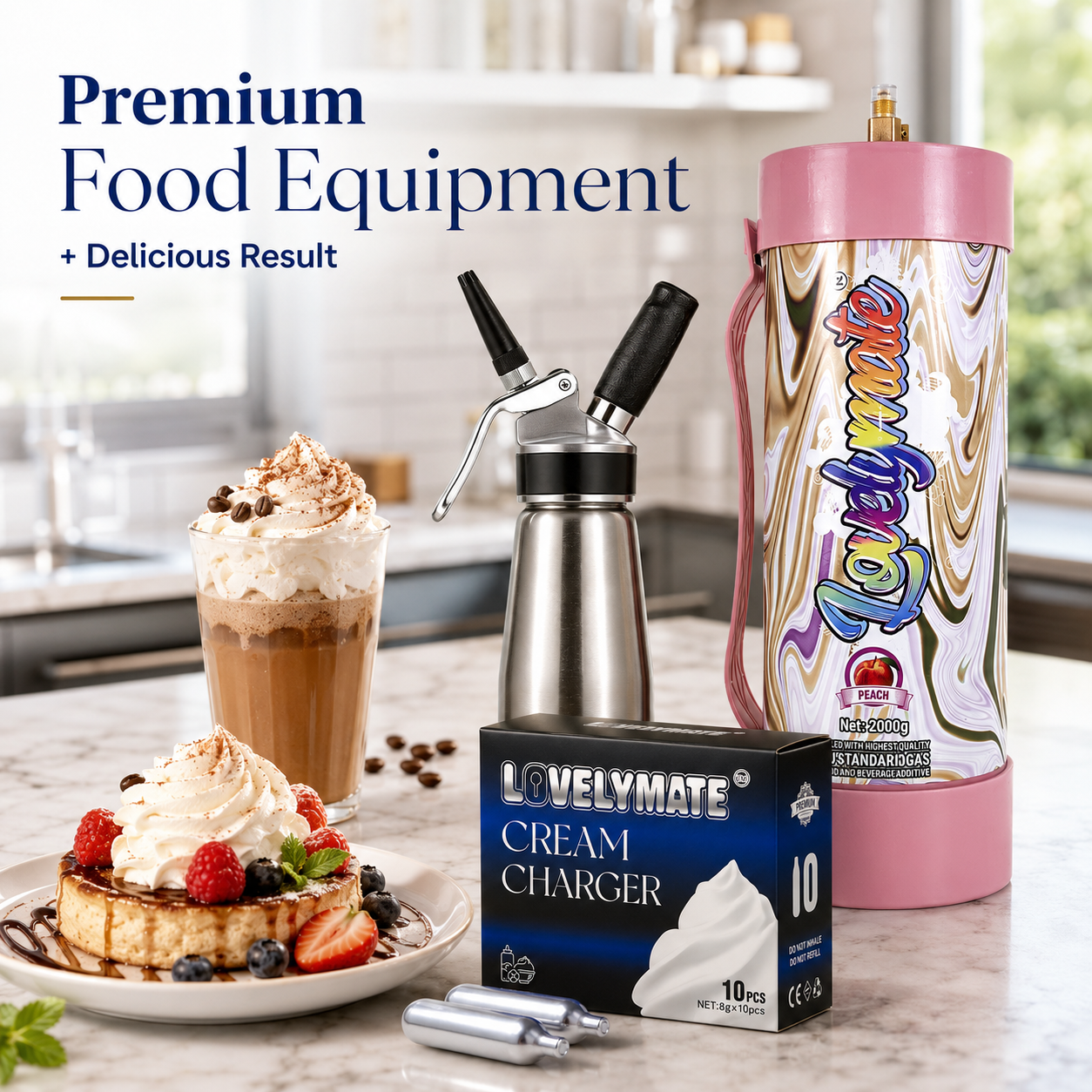
Cream Charger Sizes Explained: 8g vs 640g vs 2000g vs 3000g

Choosing the right cream charger size can make a noticeable difference in kitchen efficiency, storage planning and overall operating costs.
An occasional home user may prefer the convenience of individual 8g cartridges, while a busy café, bakery or dessert business may need a larger-capacity cylinder to reduce frequent replacements. Distributors and food-service buyers must also consider order volume, equipment compatibility, packaging and delivery requirements.
This guide compares four common cream charger formats—8g, 640g, 2000g and 3000g—to help you identify the most suitable option for your application.
Cream Charger Size Comparison
The table below provides a simple overview of how the four sizes differ.
| Size | Approximate 8g Equivalent | Best Suited For | Main Advantage |
|---|---|---|---|
| 8g | 1 cartridge | Home users, trials and low-volume use | Compact and individually portioned |
| 640g | About 80 cartridges | Small cafés, bakeries and dessert shops | Balance between capacity and portability |
| 2000g | About 250 cartridges | Busy cafés, restaurants and commercial kitchens | Fewer replacements during daily service |
| 3000g | About 375 cartridges | High-volume food service and wholesale buyers | Maximum capacity for demanding workflows |
The equivalent figures are based on nominal product weight. Actual usable output can vary depending on the dispenser, regulator, recipe, temperature, operating pressure and handling method.
8g Cream Chargers: Compact and Convenient
Traditional 8g cream chargers are individually portioned cartridges designed for compatible whipped cream dispensers.
Their compact size makes them easy to store, transport and use when only a small amount of whipped cream, foam or mousse is required. Each cartridge is used separately, giving the operator simple portion control without installing a larger cylinder system.
Best for
- Home kitchens
- Occasional dessert preparation
- Small recipe batches
- Product trials
- Businesses with very low daily usage
Main advantages
The main benefit of the 8g format is simplicity. Users can load one cartridge when needed without preparing a larger external system.
Individual cartridges are also useful for customers who want to test a dispenser or recipe before committing to a higher-capacity format.
Points to consider
For cafés, bakeries or restaurants producing whipped toppings throughout the day, individual cartridges may require frequent replacement. Staff must also open, install and dispose of more individual units as production volume increases.
For this reason, the 8g option is generally better suited to low-volume or occasional use than continuous commercial service.
640g Cream Chargers: A Flexible Mid-Size Option
A 640g cream charger offers significantly more capacity than individual cartridges while remaining relatively compact and manageable.
Based on nominal weight, one 640g cylinder contains approximately the same amount as 80 individual 8g cartridges.
This makes it a practical transition point for businesses that have outgrown small cartridges but do not yet require the largest commercial format.
Best for
- Independent cafés
- Small bakeries
- Dessert shops
- Mobile catering operations
- Businesses with moderate daily demand
Main advantages
The 640g format provides a useful balance between capacity, storage and handling.
Compared with repeatedly changing small cartridges, a compatible cylinder setup may allow staff to complete more preparation before replacing the supply. At the same time, the cylinder remains easier to handle and store than larger 2000g or 3000g options.
Points to consider
A 640g cylinder normally requires compatible connection equipment, such as an appropriate regulator, hose or filling system. Buyers should confirm compatibility before ordering rather than assuming that every cylinder works directly with every dispenser.
Businesses should also evaluate whether the 640g capacity is sufficient for peak service hours. A growing café may quickly move from moderate usage to a workload better suited to a 2000g format.
2000g Cream Chargers: Designed for Commercial Workflows
The 2000g cream charger is aimed at higher-volume food-service environments where efficiency and consistent supply are important.
By nominal weight, a 2000g cylinder is equivalent to approximately 250 individual 8g cartridges.
This larger capacity can reduce the number of interruptions caused by frequent cartridge or cylinder replacement during busy preparation periods.
Best for
- Busy coffee shops
- Restaurants
- Professional bakeries
- Catering companies
- Dessert and beverage brands
- Commercial kitchens
Main advantages
The 2000g format is suitable for businesses that regularly prepare whipped cream, mousses, culinary foams, sauces or beverage toppings.
A larger available supply can help teams organize production more efficiently, especially during busy service periods. It also reduces the number of individual cartridges that staff must count, unpack and replace.
For many commercial buyers, 2000g provides a strong balance between high capacity and practical handling.
Points to consider
Before switching to a larger cylinder, businesses should confirm:
- Daily and weekly consumption
- Available storage space
- Regulator and hose compatibility
- Staff training requirements
- Local purchasing and delivery requirements
- Expected order frequency
Choosing a larger cylinder only makes sense when the business uses enough product to benefit from the additional capacity.
3000g Cream Chargers: Built for High-Volume Demand
The 3000g cream charger is the largest option in this comparison.
Based on nominal capacity, one 3000g cylinder contains approximately the same amount as 375 individual 8g cartridges.
It is designed for businesses that value extended operation, fewer cylinder changes and more efficient inventory planning.
Best for
- High-volume cafés
- Large bakeries
- Dessert production facilities
- Catering operations
- Multi-location food-service businesses
- Distributors and wholesale buyers
Main advantages
The greatest benefit of the 3000g format is capacity.
High-volume businesses can reduce the time spent replacing smaller units and maintain a more continuous workflow during production. Distributors may also prefer larger-capacity products when serving established commercial customers.
For wholesale buyers, the 3000g format can support a product range aimed at professional kitchens with consistent and predictable demand.
Points to consider
The largest format is not automatically the best choice for every buyer.
A 3000g cylinder requires more storage space and may be less convenient for businesses with limited preparation areas or low consumption. Buyers must also consider equipment compatibility, handling procedures, shipping eligibility and inventory turnover.
Businesses should select this size based on real operating volume rather than capacity alone.
Which Cream Charger Size Should You Choose?
The right choice depends mainly on how frequently the product will be used.
Choose 8g when:
You prepare small batches, use a cream dispenser occasionally or want a compact retail-friendly format.
Choose 640g when:
You operate a small café, bakery or dessert shop and need more capacity without moving to a very large cylinder.
Choose 2000g when:
Your kitchen uses cream chargers regularly and needs fewer interruptions during normal commercial service.
Choose 3000g when:
You manage high-volume production, serve multiple business customers or require a larger supply for wholesale and distribution.
Five Factors to Consider Before Ordering
1. Daily usage volume
Estimate how much product your business actually uses during an average day and during peak periods.
A format that works on quiet weekdays may still be too small for weekends, events or seasonal demand.
2. Equipment compatibility
Do not select a cylinder based only on capacity.
Confirm that the valve, regulator, hose and dispenser setup are compatible with the chosen product. Use only equipment intended for the specific application and follow the equipment manufacturer’s instructions.
3. Storage and handling
Larger cylinders require designated storage space and suitable handling procedures.
Compressed gas cylinders should be inspected and handled carefully, stored in an appropriate dry and ventilated location, and protected from damage. OSHA’s general compressed-gas requirements emphasize safe inspection, handling, storage and use.
4. Workflow efficiency
Consider how often employees currently stop working to replace cartridges or cylinders.
For commercial kitchens, reducing unnecessary replacements can simplify preparation and help staff maintain a smoother workflow.
5. Total purchasing requirements
Compare more than the product price.
Buyers should also evaluate packaging quantity, accessories, delivery requirements, storage capacity, inventory turnover and supplier support.
Culinary Use and Safety
Nitrous oxide is used in food applications as a propellant and aerating agent, including whipped cream preparation. The FDA identifies nitrous oxide as a food-use propellant, but it also clearly warns consumers never to inhale the contents of chargers, canisters or tanks.
Cream chargers should only be used for their intended culinary purpose with compatible equipment.
Always:
- Follow the product and equipment instructions.
- Inspect the cylinder and connections before use.
- Keep cylinders away from excessive heat.
- Avoid dropping, dragging or damaging the cylinder.
- Close valves correctly when the system is not in use.
- Keep products away from children and unauthorized users.
- Never inhale or misuse the contents.
Local rules concerning sale, shipping, storage and use may vary, so commercial buyers should confirm the requirements applicable to their destination and business.
Frequently Asked Questions
Is a larger cream charger always better?
No. A larger size offers more capacity, but it also requires suitable equipment, storage and usage volume. Small businesses may find a 640g format more practical than a 3000g cylinder.
How many 8g cartridges equal a 640g cream charger?
Based on nominal product weight, 640g is equivalent to approximately 80 individual 8g cartridges.
How many 8g cartridges equal a 2000g cream charger?
A 2000g cylinder is nominally equivalent to approximately 250 individual 8g cartridges.
How many 8g cartridges equal a 3000g cream charger?
A 3000g cylinder is nominally equivalent to approximately 375 individual 8g cartridges.
Can a large cream charger connect directly to a cream dispenser?
Large cylinders generally require a compatible regulator, hose or filling connection. Buyers should confirm compatibility with the cylinder and dispenser supplier before use.
Which size is suitable for wholesale buyers?
Wholesale buyers often carry more than one size because customer needs differ. Smaller formats can serve retail and low-volume users, while 2000g and 3000g cylinders are better positioned for established commercial customers.
Find the Right Lovelymate Cream Charger Solution
Lovelymate offers multiple cream charger sizes for different culinary, food-service and wholesale requirements.
Whether you need compact cartridges for occasional preparation, a flexible mid-size format for a café, or larger-capacity cylinders for commercial production, selecting the correct size can improve purchasing efficiency and simplify daily operations.
Explore the Lovelymate product collection or contact our team for:
- Current product availability
- Wholesale quotations
- Distributor cooperation
- Custom branding support
- Packaging information
- Product compatibility guidance
Choose the capacity that matches your workflow—not simply the largest available option.
More Recommendations